Sachiko puts the kittens in a box and pushes it into the river
A Pale View of HillsSachiko puts the kittens in a box and pushes it into the river in a scene where a dispute over their care becomes a witnessed act of violence. Mariko repeatedly reminds her mother that she had promised the kittens could stay, and Etsuko offers to feed them. Sachiko nevertheless places them in a vegetable box, immerses one kitten, and sends the box into the current. The episode makes the cost of Sachiko’s decision visible to Mariko and Etsuko, while leaving the kittens’ eventual fate unconfirmed.
The promise and the dispute
The confrontation begins with Mariko insisting on a promise: she says that Sachiko had told her she could keep the kittens. As she speaks, Sachiko gently shakes a cardboard box, making the china inside rattle, then looks for cloth and begins tearing it into strips. The objects register the practical preparations around the family’s departure, but the exchange quickly turns on what can or cannot be taken along. Sachiko asks Mariko to consider their situation and says they cannot bring all the animals with them.
For a moment, Sachiko looks down at the tea set and the strips of cloth as if weighing what to do. Then she tells Mariko that things are different now and that the kittens will have to be left behind. Her irritation gives the decision a sharper edge: she dismisses Mariko’s attachment as childish and calls the animals filthy. The conflict is not simply that mother and daughter disagree about logistics. Mariko’s repeated appeal to the promise makes the change in Sachiko’s position part of the injury, while Sachiko treats the child’s insistence as an obstacle to be overcome.
The box and the intervention
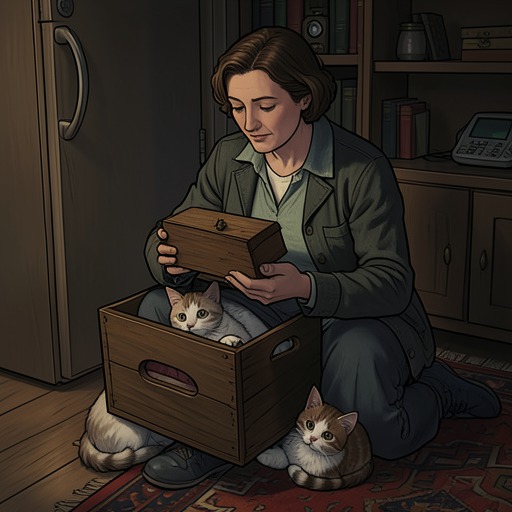
Etsuko offers a way to avoid abandoning the kittens outright: she could come and feed them from time to time, giving them a chance to find homes. Mariko turns to Etsuko and repeats that her mother had said she could keep them. Sachiko answers sharply, accuses her daughter of being deliberately awkward, and goes over to the corner where the kittens are on the tatami. When they scurry away, she takes a deep breath, turns a vegetable box onto its side so that its wire-grid panels face upward, and drops the kittens into it one by one.
Sachiko then asks Mariko for the kitten she is still holding. Mariko continues to hold it and looks toward Etsuko. The narration does not say what happens to that kitten at this point, and the distinction matters: the scene records Mariko’s refusal to surrender it, but does not establish that Sachiko takes it. Etsuko’s offer and Mariko’s appeal mark the available alternatives—care, or at least the possibility of keeping the animals safe—before Sachiko acts on her decision. Neither persuades her to abandon the plan.
Immersion and release into the river
Etsuko goes down the muddy slope to where Sachiko is kneeling and quietly asks whether they could let the kittens loose, since someone might want them. Sachiko looks into the box through the wire gauze, slides open a panel, takes out a kitten, and holds it in both hands. After looking at it for a few seconds, she tells Etsuko that it is just an animal. She then puts the kitten into the water and holds it there, both hands beneath the surface. The corners of her summer kimono sleeves touch the water as she remains bent over it.
Sachiko glances back toward Mariko while her hands are still submerged. Etsuko follows her gaze: Mariko is standing at the top of the slope, watching with a blank expression, her hands behind her back. Sachiko brings the kitten out and says it is still alive. She points to the dirty water, drops the soaked kitten back into the box, and shows Etsuko the scratch marks on her wrists. These details establish that the kitten survives the immersion long enough for Sachiko to return it to the box; they do not establish what happens to it afterward.
Sachiko then pushes the vegetable box over the bank. It rolls into the river, and she leans forward to hold it down so it will not float away. When she finally pushes it with both hands, the box bobs in the water, sinks further, and is carried downstream by the current. Mariko runs along the riverbank to watch it, stopping as it catches briefly in reeds and then frees itself. She runs again and watches from another point as only a small corner remains visible above the surface. The account ends without confirming whether the kittens survive or where the box goes.
Witnessing and significance
The scene’s central reversal is from a child’s expectation of keeping the kittens to their removal from her care, with Etsuko present but unable to change Sachiko’s decision. Its progression is deliberately concrete: a kitten is taken from the box, held beneath the water, lifted alive, and put back; then the box itself is pushed into the river. Sachiko’s emphasis on the water’s dirtiness and the scratches on her wrists shifts attention to the immediate unpleasantness of the act, while Mariko remains the silent witness to its consequence. The contrast does not explain Sachiko’s motives, but it shows the act continuing despite Etsuko’s intervention and Mariko’s presence.
Mariko’s watchfulness gives the disposal a further consequence without supplying an interpretation from her. She does not speak as the box moves away; she runs beside the river and keeps following its progress. Sachiko, by contrast, brushes mud from her knees, squeezes water from her kimono sleeves, and suggests that they go inside because the insects are intolerable. The contrast leaves the scene on two different responses to the same event: Mariko remains fixed on the disappearing box, while Sachiko turns back toward ordinary discomforts. The kittens’ fate stays unresolved, but the rupture between Sachiko’s decision and Mariko’s repeated appeal is unmistakable.